
Human Behaviour in Hospital Waiting
Interaction Design
Individual
6 Weeks
A communication system for hospital waiting designed to reduce constant checking while keeping people aware of what matters in their journey. An exploration of attention, uncertainty, and human behaviour in waiting.
Observation
Hospital waiting is filled with small acts of observation.
People watch doors,
follow staff movements,
check screens and
look at others being called
using whatever changes around them as clues to understand what might happen next.

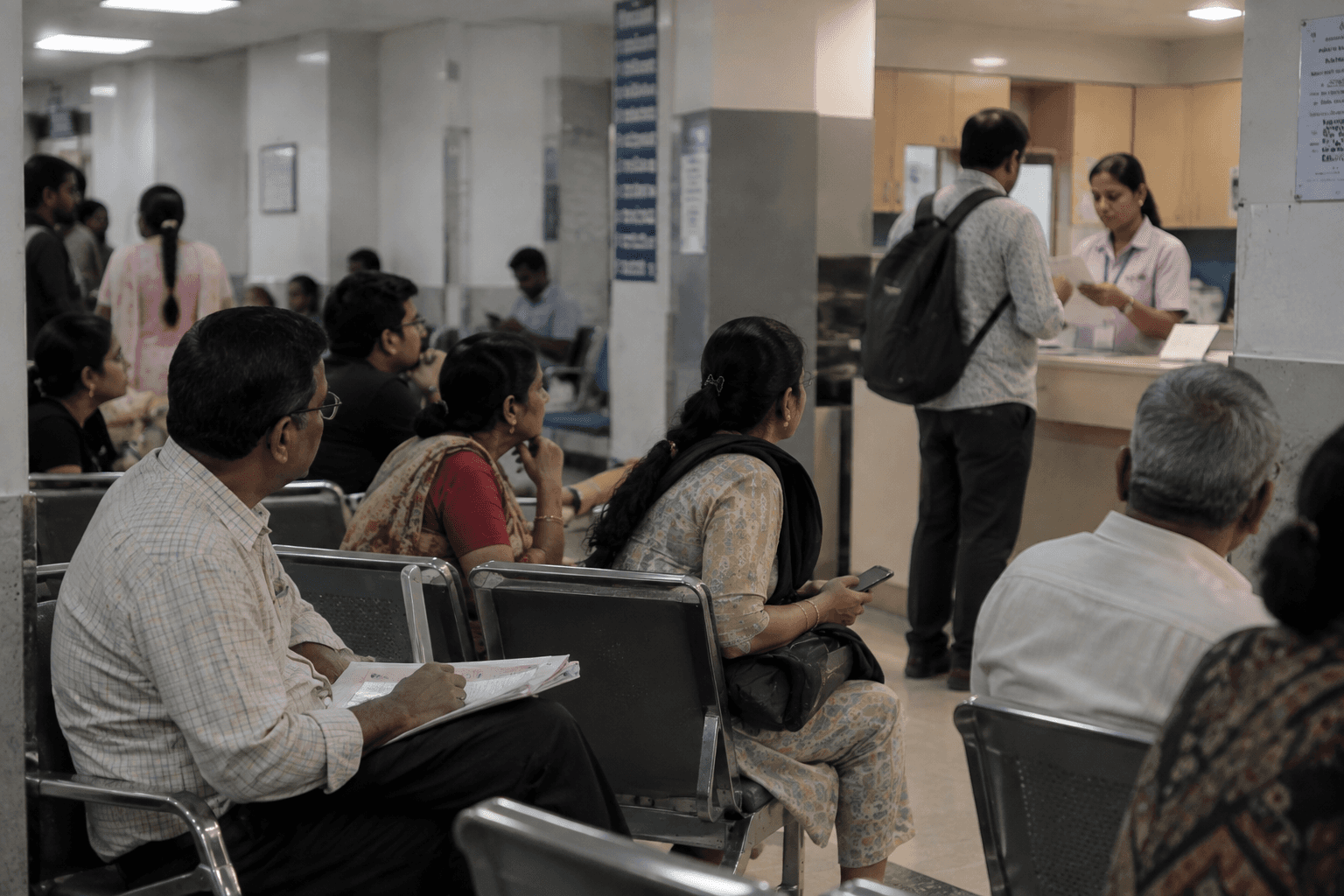

Movement becomes a cue.
A nearby interaction may or may not be relevant.
A door opens. Attention shifts.
Understanding Waiting
Hospital waiting takes place across different spaces, situations and stages of a person’s journey.
The reason for waiting may change, but people still need to understand what is happening, whether things are progressing, and what comes next.
A JOURNEY WITH MULTIPLE WAITING POINTS

DIFFERENT SITUATIONS , SIMILIAR BEHAVIOUR
First Visit
Waiting for
consultation
Waiting for Information
Between Tasks
Attendent Waiting
What happens next?
When will I be called?
Has anything changed?
When do I need
to move?
When will I hear something?
What People are Trying To Know
While waiting, people are not simply looking for information. They are trying to understand what is happening around them and whether it changes what they need to do.
HAPPENING
Is anything happening?
Looking for signs that the process has started or something has changed.
PROGRESS
Is my journey moving forward?
Trying to understand whether there is any progress while waiting.
RELEVANCE
Is that change
about me?
Interpreting whether a person, announcement, door or screen concerns them.
ACTION
Do I need to do something?
Figuring out whether it is time to move, respond, prepare or wait.

A behavioural attention journey showing attention rising with cues, dropping when nothing happens, and rising again when a new cue appears.
WHAT WAITING BECOMES
WAITING BECOMES A MONITORING TASK
Across these behaviours, waiting emerged as an active process of watching, checking and interpreting. People continuously monitor their surroundings to understand whether something has changed and whether it requires their attention.

Psychographical & Behavioural Persona

First time hospital visitor
ABOUT
A person visiting a hospital for the first time, either for themselves or accompanying someone. They are unfamiliar with the process, environment and informal cues.
NEED
To stay aware of what matters in their journey while feeling free to stop constantly checking.
VALUES
Flexibility & Freedom
Transparency & Awareness
System Initiated Empathy
Relevance
Privacy
Accessibility
GOALS
Understand what is happening.
Know whether their journey is progressing
Recognise when a change becomes relevant to them
Know when they need to act.
MINDSET
Observes before approaching staff
Tries to understand the process
Wants to use waiting time freely
Feels responsible for noticing important changes.
Doesn’t want to miss their next step.
PAIN POINTS
Unclear progress.
No visible indication that their journey is moving.
Unclear whether something is relevant to them.
Unclear next action.
Constant checking.
Fear of missing something important.
Dependence on staff for confirmation.
INTENT TRIGGERS
No visible progress for a long time
A doctor member appears
A consultation door opens
Someone else gets called
A screen or indicator changes
People around them suddenly move
They need to leave their seat
OBSERVATIONS
Looks at doctors, doors, counters and screens.
Watches other visitors to understand what is happening.
Repeatedly checks for movement or change.
Asks staff or other visitors for confirmation.
Distracts themselves while remaining alert.
Problem Statement
People waiting in hospitals continuously monitor doors, doctors, counters and screens because they cannot easily tell whether anything is happening, whether the process is progressing, whether a change is relevant to them, or whether they need to do something next.
This uncertainty makes them repeatedly check their surroundings, making them responsible for constantly monitoring and interpreting changes in their journey.
WHY
People shouldn't have to continuously monitor their hospital journey to know when something matters.
WHAT
A communication system can monitor changes in a person's journey, determine what is relevant, and communicate only when attention is needed.
PAYOFF
People can step away from constant checking while staying aware of what matters and when action is required.
Attention Delegation (Selected Direction)
Instead of asking the person to continuously monitor the hospital, the system takes responsibility for monitoring their journey. It identifies meaningful changes, determines whether they are relevant, and communicates only when the person’s attention is needed.
HAPPENING
Notices what is happening in the hospital
PROGRESS
Understands whether your journey is moving forward
RELEVANCE
Determines if the change is relevant to you
ACTION
Let you know when action is needed

PERSONAL ATTENTION CLIP
A small, non-medical interface that attaches to something the visitor already carries. It stays quiet during ordinary waiting and becomes noticeable only when the system determines that attention is needed.
THE OBJECT
A personal attention interface that travels with the visitor.
Designed to attach to an existing hospital file or personal belonging, keeping the interaction familiar and non intrusive.


ATTENTION STATES
How the system communicates changing levels of attention.
Light communicates the attention state, while gentle vibration helps capture attention when action is required.

IN CONTEXT
How the clip fits into an waiting moment.
The visitor does not monitor the clip. The clip gets their attention when it matters.


CARRY
Person receives the hospital file with the clip attached.
Light: OFF
PROGRESS
Something changes, but no action is required.
Light: BLUE
RELEVANCE
The change becomes relevant to their journey.
Light: YELLOW & SUTLE VIBRATION
RESPOND
Action is required. The visitor notices and prepares for the next step.
Light: Red & VIBRATION
Skills Developed
Understanding human behaviour in everyday environments
Developing communication systems
Working with physical and sensory interactions
Visualising complex systems and behaviours
Using light, colour and movement as communication cues


Human Behaviour in Hospital Waiting
Interaction Design
Individual
6 Weeks
A communication system for hospital waiting designed to reduce constant checking while keeping people aware of what matters in their journey. An exploration of attention, uncertainty, and human behaviour in waiting.
Observation
Hospital waiting is filled with small acts of observation.
People watch doors,
follow staff movements,
check screens and
look at others being called
using whatever changes around them as clues to understand what might happen next.
Movement becomes a cue.
A nearby interaction may or may not be relevant.
A door opens. Attention shifts.
Understanding Waiting
Hospital waiting takes place across different spaces, situations and stages of a person’s journey.
The reason for waiting may change, but people still need to understand what is happening, whether things are progressing, and what comes next.
A JOURNEY WITH MULTIPLE WAITING POINTS
DIFFERENT SITUATIONS , SIMILIAR BEHAVIOUR
First Visit
Waiting for
consultation
Waiting for Information
Between Tasks
Attendent Waiting
What happens next?
When will I be called?
Has anything changed?
When do I need
to move?
When will I hear something?
What People are Trying To Know
While waiting, people are not simply looking for information. They are trying to understand what is happening around them and whether it changes what they need to do.
HAPPENING
Is anything happening?
Looking for signs that the process has started or something has changed.
PROGRESS
Is my journey moving forward?
Trying to understand whether there is any progress while waiting.
RELEVANCE
Is that change
about me?
Interpreting whether a person, announcement, door or screen concerns them.
ACTION
Do I need to do something?
Figuring out whether it is time to move, respond, prepare or wait.
A behavioural attention journey showing attention rising with cues, dropping when nothing happens, and rising again when a new cue appears.
WHAT WAITING BECOMES
WAITING BECOMES A MONITORING TASK
Across these behaviours, waiting emerged as an active process of watching, checking and interpreting. People continuously monitor their surroundings to understand whether something has changed and whether it requires their attention.
Psychographical & Behavioural Persona
First time hospital visitor
ABOUT
A person visiting a hospital for the first time, either for themselves or accompanying someone. They are unfamiliar with the process, environment and informal cues.
NEED
To stay aware of what matters in their journey while feeling free to stop constantly checking.
VALUES
Flexibility & Freedom
Transparency & Awareness
System Initiated Empathy
Relevance
Privacy
Accessibility
GOALS
Understand what is happening.
Know whether their journey is progressing
Recognise when a change becomes relevant to them
Know when they need to act.
MINDSET
Observes before approaching staff
Tries to understand the process
Wants to use waiting time freely
Feels responsible for noticing important changes.
Doesn’t want to miss their next step.
PAIN POINTS
Unclear progress.
No visible indication that their journey is moving.
Unclear whether something is relevant to them.
Unclear next action.
Constant checking.
Fear of missing something important.
Dependence on staff for confirmation.
INTENT TRIGGERS
No visible progress for a long time
A doctor member appears
A consultation door opens
Someone else gets called
A screen or indicator changes
People around them suddenly move
They need to leave their seat
OBSERVATIONS
Looks at doctors, doors, counters and screens.
Watches other visitors to understand what is happening.
Repeatedly checks for movement or change.
Asks staff or other visitors for confirmation.
Distracts themselves while remaining alert.
Problem Statement
People waiting in hospitals continuously monitor doors, doctors, counters and screens because they cannot easily tell whether anything is happening, whether the process is progressing, whether a change is relevant to them, or whether they need to do something next.
This uncertainty makes them repeatedly check their surroundings, making them responsible for constantly monitoring and interpreting changes in their journey.
WHY
People shouldn't have to continuously monitor their hospital journey to know when something matters.
WHAT
A communication system can monitor changes in a person's journey, determine what is relevant, and communicate only when attention is needed.
PAYOFF
People can step away from constant checking while staying aware of what matters and when action is required.
Attention Delegation (Selected Direction)
Instead of asking the person to continuously monitor the hospital, the system takes responsibility for monitoring their journey. It identifies meaningful changes, determines whether they are relevant, and communicates only when the person’s attention is needed.
HAPPENING
Notices what is happening in the hospital
PROGRESS
Understands whether your journey is moving forward
RELEVANCE
Determines if the change is relevant to you
ACTION
Let you know when action is needed
PERSONAL ATTENTION CLIP
A small, non-medical interface that attaches to something the visitor already carries. It stays quiet during ordinary waiting and becomes noticeable only when the system determines that attention is needed.
THE OBJECT
A personal attention interface that travels with the visitor.
Designed to attach to an existing hospital file or personal belonging, keeping the interaction familiar and non intrusive.
ATTENTION STATES
How the system communicates changing levels of attention.
Light communicates the attention state, while gentle vibration helps capture attention when action is required.
IN CONTEXT
How the clip fits into an waiting moment.
The visitor does not monitor the clip. The clip gets their attention when it matters.
CARRY
Person receives the hospital file with the clip attached.
Light: OFF
PROGRESS
Something changes, but no action is required.
Light: BLUE
RELEVANCE
The change becomes relevant to their journey.
Light: YELLOW & SUTLE VIBRATION
RESPOND
Action is required. The visitor notices and prepares for the next step.
Light: Red & VIBRATION
Let’s create something meaningful together.
Feel Free To Reach Out.
+91 9406650418

2026 Anushka Saxena
Designed & Developed by me.
Skills Developed
Understanding human behaviour in everyday environments
Developing communication systems
Working with physical and sensory interactions
Visualising complex systems and behaviours
Using light, colour and movement as communication cues
Human Behaviour in
Hospital Waiting
Interaction Design
Individual
6 Weeks
A communication system for hospital waiting designed to reduce constant checking while keeping people aware of what matters in their journey. An exploration of attention, uncertainty, and human behaviour in waiting.
Observation
Hospital waiting is filled with small acts of observation.
People watch doors,
follow staff movements,
check screens and
look at others being called
using whatever changes around them as clues to understand what might happen next.
Movement becomes a cue.
A nearby interaction may or may not be relevant.
A door opens. Attention shifts.
Understanding Waiting
Hospital waiting takes place across different spaces, situations and stages of a person’s journey.
The reason for waiting may change, but people still need to understand what is happening, whether things are progressing, and what comes next.
A JOURNEY WITH MULTIPLE WAITING POINTS
DIFFERENT SITUATIONS , SIMILIAR BEHAVIOUR
First Visit
Waiting for
consultation
Waiting for Information
Between Tasks
Attendent Waiting
What happens next?
When will I be called?
Has anything changed?
When do I need to move?
When will I hear something?
What People are Trying To Know
While waiting, people are not simply looking for information. They are trying to understand what is happening around them and whether it changes what they need to do.
HAPPENING
Is anything happening?
Looking for signs that the process has started or something has changed.
PROGRESS
Is my journey moving forward?
Trying to understand whether there is any progress while waiting.
RELEVANCE
Is that change
about me?
Interpreting whether a person, announcement, door or screen concerns them.
ACTION
Do I need to do something?
Figuring out whether it is time to move, respond, prepare or wait.
The logo originated from the letters T, I, and K.
Through structural exploration and proportion, the forms evolved into a unified symbol.
WHAT WAITING BECOMES
WAITING BECOMES A MONITORING TASK
Across these behaviours, waiting emerged as an active process of watching, checking and interpreting. People continuously monitor their surroundings to understand whether something has changed and whether it requires their attention.
Psychographical & Behavioural Persona
First time hospital visitor
ABOUT
A person visiting a hospital for the first time, either for themselves or accompanying someone. They are unfamiliar with the process, environment and informal cues.
NEED
To stay aware of what matters in their journey while feeling free to stop constantly checking.
VALUES
Flexibility & Freedom
Transparency & Awareness
System Initiated Empathy
Relevance
Privacy
Accessibility
GOALS
Understand what is happening.
Know whether their journey is progressing
Recognise when a change becomes relevant to them
Know when they need to act.
MINDSET
Observes before approaching staff
Tries to understand the process
Wants to use waiting time freely
Feels responsible for noticing important changes.
Doesn’t want to miss their next step.
PAIN POINTS
Unclear progress.
No visible indication that their journey is moving.
Unclear whether something is relevant to them.
Unclear next action.
Constant checking.
Fear of missing something important.
Dependence on staff for confirmation.
INTENT TRIGGERS
No visible progress for a long time
A doctor member appears
A consultation door opens
Someone else gets called
A screen or indicator changes
People around them suddenly move
They need to leave their seat
OBSERVATIONS
Looks at doctors, doors, counters and screens.
Watches other visitors to understand what is happening.
Repeatedly checks for movement or change.
Asks staff or other visitors for confirmation.
Distracts themselves while remaining alert.
Problem Statement
People waiting in hospitals continuously monitor doors, doctors, counters and screens because they cannot easily tell whether anything is happening, whether the process is progressing, whether a change is relevant to them, or whether they need to do something next.
This uncertainty makes them repeatedly check their surroundings, making them responsible for constantly monitoring and interpreting changes in their journey.
WHY
People shouldn't have to continuously monitor their hospital journey to know when something matters.
WHAT
A communication system can monitor changes in a person's journey, determine what is relevant, and communicate only when attention is needed.
PAYOFF
People can step away from constant checking while staying aware of what matters and when action is required.
Attention Delegation (Selected Direction)
Instead of asking the person to continuously monitor the hospital, the system takes responsibility for monitoring their journey. It identifies meaningful changes, determines whether they are relevant, and communicates only when the person’s attention is needed.
HAPPENING
Notices what is happening in the hospital
PROGRESS
Understands whether your journey is moving forward
RELEVANCE
Determines if the change is relevant to you
ACTION
Let you know when action is needed
PERSONAL ATTENTION CLIP
A small, non-medical interface that attaches to something the visitor already carries. It stays quiet during ordinary waiting and becomes noticeable only when the system determines that attention is needed.
THE OBJECT
A personal attention interface that travels with the visitor.
Designed to attach to an existing hospital file or personal belonging, keeping the interaction familiar and non intrusive.
ATTENTION STATES
How the system communicates changing levels of attention.
Light communicates the attention state, while gentle vibration helps capture attention when action is required.
IN CONTEXT
How the clip fits into an waiting moment. The visitor does not monitor the clip. The clip gets their attention when it matters.
CARRY
Person receives the hospital file with the clip attached.
Light: OFF
PROGRESS
Something changes, but no action is required.
Light: BLUE
RELEVANCE
The change becomes relevant to their journey.
Light: YELLOW & SUTLE VIBRATION
RESPOND
Action is required. The visitor notices and prepares for the next step.
Light: Red & VIBRATION
Skills Developed
Understanding human behaviour in everyday environments
Developing communication systems
Working with physical and sensory interactions
Visualising complex systems and behaviours
Using light, colour and movement as communication cues
SOMETHING IN MIND?
Always open to new ideas,
conversations and possibilities.
+91 9406650418
Let's Talk
Let's connect
Take a look

2026 Anushka Saxena
Designed & Developed by me.
SOMETHING IN MIND?
Always open to new ideas,
conversations and possibilities.
+91 9406650418
Let's Talk
Let's connect
Take a look

2026 Anushka Saxena
Designed & Developed by me.
SOMETHING
IN MIND?
Always open to new ideas,
conversations and possibilities.
+91 9406650418
Let's Talk
Let's connect
Take a look
